Safaricom Profit Jumps 72% In HY27 As Ethiopia Losses Narrow
Safaricom plc grew profit for the period 72.49 percent to Kshs50.35 billion in the six months ended 30 September 2026, as EBITDA margin expanded to 55.28 percent and Ethiopia's losses narrowed sharply.
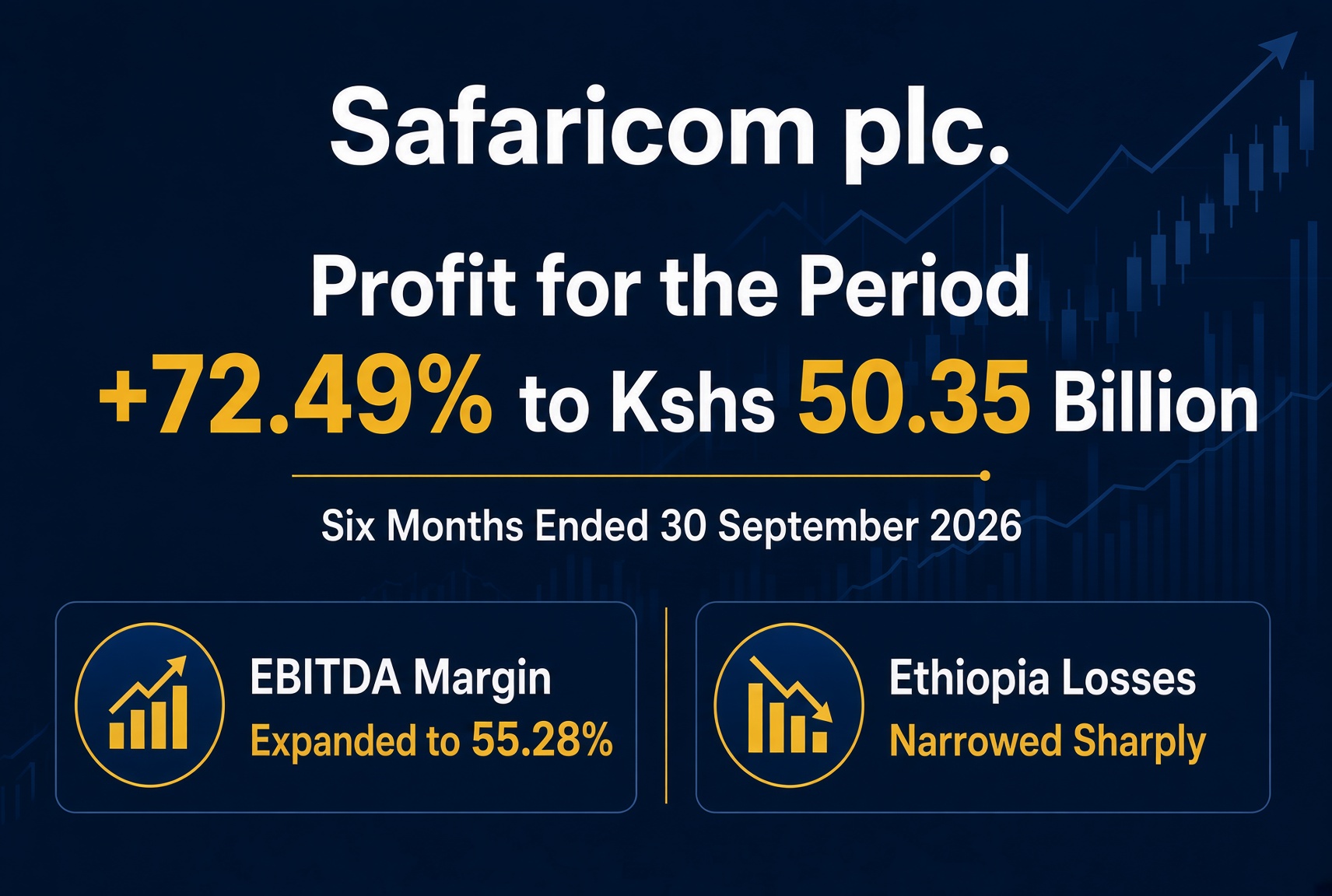
Safaricom profit jumps 72.49 percent in HY27 as Ethiopia losses narrow
Safaricom plc grew profit for the period 72.49 percent to Kshs50.35 billion for the six months ended 30 September 2026, from Kshs29.19 billion a year earlier. Group EBITDA rose 27.54 percent to Kshs129.18 billion and EBIT rose 39.76 percent to Kshs91.14 billion, as service revenue grew 13.11 percent to Kshs226.06 billion.
Not all of that growth reached shareholders in equal measure. Net income attributable to owners of the parent, the profit base for earnings per share and dividends, grew 35.94 percent to Kshs58.15 billion from Kshs42.78 billion. That is a smaller percentage gain than the total figure, even though both numbers are driven by the same underlying improvement.
Losses attributable to non-controlling interests, mostly tied to Safaricom's Ethiopia unit, narrowed 42.58 percent to Kshs7.80 billion from Kshs13.59 billion, reflecting Ethiopia's own operating loss narrowing sharply, a genuine improvement in that business. That improvement sits against a smaller prior-year base in total group profit than in owners' profit alone, which is why the same underlying gain produces a larger percentage move in the total figure. Safaricom's own headline metric is net income excluding minority interest, since that is the profit pool EPS and dividends are actually drawn from.
Safaricom plc HY27 Snapshot (Kshs millions, Group, six months ended 30 September)
| Metric | HY27 | HY26 | YoY Change |
|---|---|---|---|
| Service revenue | 226,062.9 | 199,865.2 | +13.11% |
| Total revenue | 233,683.2 | 204,708.2 | +14.15% |
| Direct costs | (57,549.2) | (50,790.2) | +13.31% |
| Other operating expenses | (44,536.9) | (50,121.1) | -11.14% |
| EBITDA | 129,184.7 | 101,288.0 | +27.54% |
| Depreciation and amortisation | (38,043.4) | (36,074.5) | +5.46% |
| EBIT (Operating profit) | 91,141.3 | 65,213.5 | +39.76% |
| Net finance cost | (9,910.3) | (9,891.8) | +0.19% |
| Profit before income tax | 81,326.8 | 55,239.8 | +47.23% |
| Income tax expense | (30,975.7) | (26,049.9) | +18.91% |
| Profit for the period (total) | 50,351.1 | 29,189.9 | +72.49% |
| Attributable to owners of the parent | 58,154.2 | 42,780.0 | +35.94% |
| Attributable to non-controlling interests | (7,803.1) | (13,590.1) | -42.58% |
| Earnings per share (Shs) | 1.45 | 1.07 | +35.51% |
Source: Safaricom plc condensed unaudited results for the six months ended 30 September 2026.
- To analyse Safaricom's reported numbers over the last four years, click here, or see the statements themselves on its financials view.
EBITDA margin expanded to 55.28 percent of total revenue from 49.48 percent, and EBIT margin widened to 39.00 percent from 31.86 percent. Other operating expenses fell 11.14 percent to Kshs44.54 billion even as direct costs grew 13.31 percent in line with revenue. Depreciation and amortisation grew more slowly than revenue, easing to 16.28 percent of revenue from 17.62 percent.
The effective tax rate fell to 38.09 percent from 47.16 percent, adding to the gap between the growth in profit after tax and the growth in profit before tax.
Kenya remained the larger and steadier half of the business. The company said Kenya service revenue grew 11.3 percent to KShs215.96 billion, with M-PESA revenue up 13.6 percent to KShs100.07 billion and now contributing 46.3 percent of Kenya service revenue. M-PESA transaction value rose 16.6 percent to KShs23.56 trillion, and the merchant base grew 90.3 percent to 4.51 million. Connectivity revenue grew 7.7 percent to KShs103.38 billion, and fixed services and IoT revenue grew 25.5 percent to KShs12.51 billion.
Ethiopia grew faster off a smaller base and continued narrowing its losses. The company said Ethiopia service revenue grew 71.6 percent to KShs10.62 billion, with mobile data growing 90.2 percent to KShs7.85 billion and now 74.0 percent of Ethiopia service revenue. Ethiopia's EBITDA loss narrowed 96.5 percent to KShs0.43 billion, and its operating loss narrowed 53.4 percent to KShs11.35 billion.
Total assets grew 12.82 percent year on year to Kshs573.80 billion from Kshs508.59 billion. Total equity grew more slowly, up 9.59 percent to Kshs236.32 billion, while total liabilities grew 15.20 percent to Kshs337.48 billion. Non-current liabilities drove most of that increase, up 43.11 percent to Kshs186.25 billion, while current liabilities actually fell 7.11 percent to Kshs151.23 billion. Within current liabilities, short-term borrowings fell 18.21 percent year on year to Kshs45.65 billion, after dropping sharply to Kshs25.54 billion at the end of March and partly rebuilding since. The current portion of lease liabilities rose 23.28 percent to Kshs13.26 billion from Kshs10.75 billion a year earlier.
Net cash from operating activities rose 41.99 percent to Kshs91.92 billion from Kshs64.74 billion. Net cash used in investing activities widened 34.43 percent to Kshs56.54 billion. Dividends paid in cash rose 73.06 percent to Kshs45.56 billion from Kshs26.33 billion, reflecting the final dividend for the year ended 31 March 2026 settled during this half. Cash and cash equivalents closed the period at Kshs40.54 billion, up 34.08 percent from Kshs30.23 billion a year earlier.
- Safaricom's payout history sits on its dividend view. To track record dates and payment dates across the NSE, visit ApexHub Insights - Upcoming Dividends.
Safaricom plc HY27 Key Ratios
| Ratio | 30 Sep 2026 | 30 Sep 2025 |
|---|---|---|
| EBITDA margin | 55.28% | 49.48% |
| EBIT margin | 39.00% | 31.86% |
| Net profit margin | 21.55% | 14.26% |
| Effective tax rate | 38.09% | 47.16% |
| Equity-to-assets ratio | 41.18% | 42.40% |
| Debt-to-equity ratio | 142.81% | 135.86% |
| Debt-to-assets ratio | 58.82% | 57.60% |
| Current ratio | 0.63x | 0.55x |
Source: ApexHub Insights calculations. Every ratio above compares 30 September 2026 against 30 September 2025 on a like-for-like basis.
Margins expanded across the board: EBITDA margin to 55.28 percent from 49.48 percent, EBIT margin to 39.00 percent from 31.86 percent, and net margin to 21.55 percent from 14.26 percent. Revenue growth outpacing cost growth and the lower effective tax rate both drove the expansion.
Leverage moved the other way, though a true year-on-year comparison shows a smaller shift than a comparison against March alone would suggest. Equity-to-assets fell to 41.18 percent from 42.40 percent a year earlier, and debt-to-equity rose to 142.81 percent from 135.86 percent, as total liabilities, mostly non-current liabilities, grew faster than equity. The current ratio actually improved to 0.63 times from 0.55 times, though it stayed below 1, a position Safaricom has carried for years given its strong, recurring operating cash generation and prepaid service structure.
- Whether Safaricom's operating cash covers its short-term bills is tracked on its liquidity view, alongside the operating cash flow ratio.
- Follow Safaricom's leverage trend on its solvency view, or compare it with other listed telecommunications companies on its peers view.
Safaricom's results sit against a split macro backdrop. The company said Kenya's inflation stood at 6.8 percent in September 2026, with the shilling broadly stable near Kshs129 per US dollar. CBK data since then shows that trend continuing, with 12-month inflation rising to 7.32 percent in October, so the backdrop looks less settled than the September snapshot alone suggests. Ethiopia's inflation stood at 14.9 percent in September, with continued currency pressure, yet Safaricom's Ethiopia unit still grew revenue faster than Kenya and narrowed its losses, a sign the business is scaling despite the harder operating environment.
Looking ahead, the company said it remains focused on "sustaining growth in Kenya, scaling Ethiopia and accelerating our transition to a purpose-led technology company." Group chief executive Peter Ndegwa pointed to continued momentum in connectivity and M-PESA in Kenya, and "sustained customer growth, increasing usage and disciplined execution" strengthening the Ethiopia business.
Bottom line for investors: Safaricom's HY27 headline number, profit for the period up 72.49 percent, is real, and margins expanded across EBITDA, EBIT and net profit alongside it. The shareholder-relevant figure is net income attributable to owners, up 35.94 percent, still strong but measured against a different, larger base than the total profit figure. Both numbers reflect the same genuine improvement, including Ethiopia's operating loss narrowing sharply, just split differently between Safaricom's own shareholders and minority co-investors in Ethiopia. The balance sheet took on somewhat more leverage over the year, debt-to-equity up to 142.81 percent from 135.86 percent a year earlier, funding continued investment in both markets. Investors should track EBIT margin, the owners'-attributable profit line and Ethiopia's loss trajectory for the fullest picture.
Source: Safaricom plc condensed unaudited results for the six months ended 30 September 2026.
Question or correction?
Spotted a figure that looks wrong, or want something in this note explained? It comes straight to us, and is not published.
Related research
Run the numbers
- Financial Planner
Goals, income, debt and net worth projected in one plan.
- Statement Analyzer
Turn bank statements into categorised income and expenses.
- Stock Screener
Screen the NSE on the same fundamentals this note is built on.
- Income Tax Calculator
Run your own PAYE, reliefs and net pay on the current bands.