Longhorn Publishers Posts Kshs950 Million Loss, Equity Turns Negative
Longhorn Publishers Plc reported a Kshs949.67 million loss after tax for the year ended 30 June 2026, pushing total equity negative for the first time, as a Kshs460.29 million impairment charge and the derecognition of Kshs262 million in deferred tax assets offset 20.67 percent revenue growth.
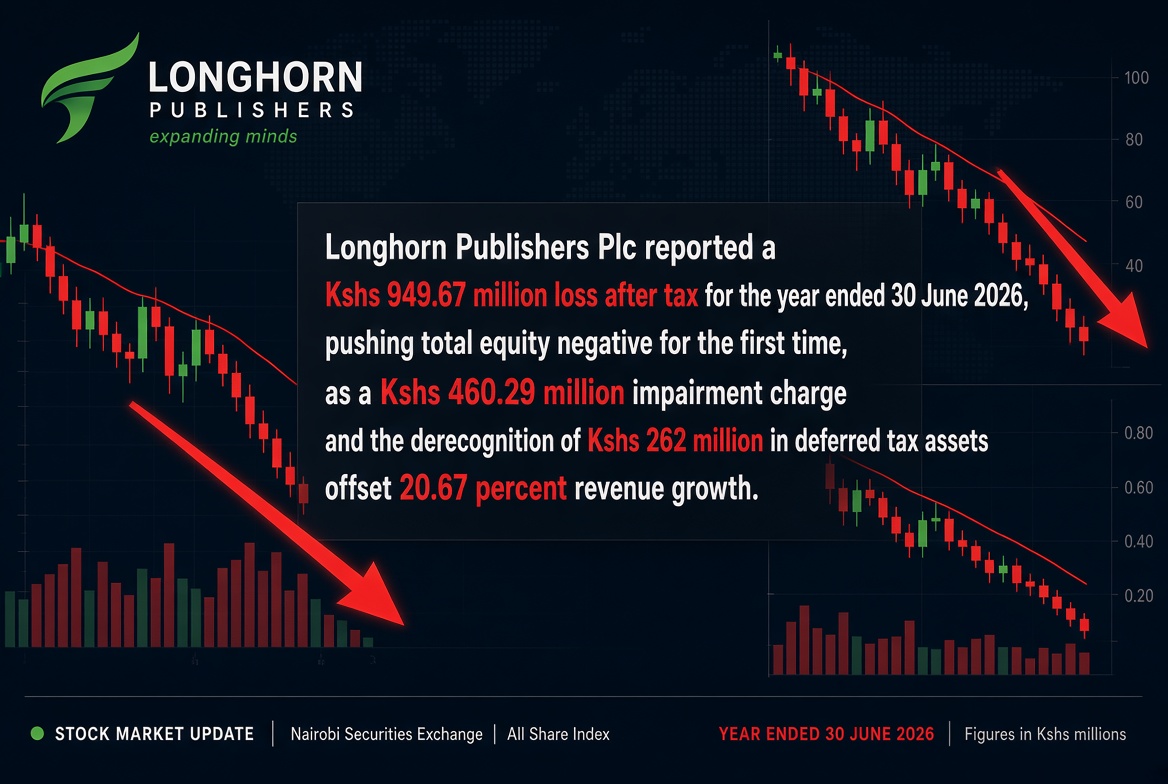
Longhorn Publishers posts Kshs950 million loss, equity turns negative
Longhorn Publishers Plc, the Nairobi Securities Exchange-listed educational publisher, reported a loss after tax of Kshs949.67 million for the year ended 30 June 2026, more than three and a half times the Kshs261.44 million loss posted a year earlier. The loss pushed total equity negative for the first time, to a deficit of Kshs1.03 billion from a thin Kshs18.11 million a year earlier. Revenue grew 20.67 percent to Kshs811 million from Kshs672.09 million, but a Kshs460.29 million impairment charge embedded in cost of sales and the derecognition of Kshs262 million in deferred tax assets drove the much larger loss.
The company said the year was marked by continued implementation of a revised school curriculum in its key markets, delays in institutional procurement, and constrained funding for the business. Longhorn's shares (LKL) were trading at Kshs2.61 on Monday 2 November 2026, down Kshs0.16, or 5.78 percent, on the day.
Longhorn Publishers Plc FY2025/26 Snapshot (Kshs'000)
| Metric | FY2026 | FY2025 | YoY Change |
|---|---|---|---|
| Revenue | 810,998 | 672,088 | +20.67% |
| Cost of sales | (913,840) | (521,027) | +75.39% |
| of which: cost of sales, ordinary activities | (453,546) | (383,455) | +18.28% |
| of which: impairment losses in cost of sales | (460,294) | (137,572) | +234.58% |
| Gross (loss)/profit | (102,842) | 151,061 | -168.08% |
| Gross profit excluding impairment losses | 357,452 | 288,633 | +23.84% |
| Other income | 5,911 | 7,802 | -24.24% |
| Operating expenses | (405,367) | (328,119) | +23.54% |
| Finance costs | (182,231) | (203,893) | -10.62% |
| Loss before tax | (684,529) | (373,149) | -83.45% |
| Income tax (expense)/credit | (265,143) | 111,705 | -337.36% |
| Loss after tax | (949,672) | (261,444) | -263.24% |
| Other comprehensive (loss)/income | (96,098) | 256,123 | -137.52% |
| Total comprehensive loss | (1,045,770) | (5,321) | -19553.64% |
Source: Longhorn Publishers Plc audited consolidated results for the year ended 30 June 2026. YoY Change is a mechanical read of whether each line moved up or down in value, not a judgement on whether that movement was good or bad news.
- To analyse Longhorn Publishers' reported numbers over the last four years, click here, or see the statements themselves on its financials view.
Revenue growth was genuine. The underlying trading story improved too: gross profit excluding impairment losses rose 23.84 percent to Kshs357.45 million from Kshs288.63 million, and the margin on that basis widened to 44.08 percent of revenue from 42.95 percent. The headline gross result tells a different story only because of what sits inside cost of sales.
A Kshs460.29 million impairment charge, more than three times the Kshs137.57 million taken a year earlier, is booked within cost of sales and turned a Kshs151.06 million gross profit into a Kshs102.84 million gross loss. The company attributes the bulk of it to the revised curriculum, which left older curriculum-linked publishing investments impaired. Operating expenses rose 23.54 percent to Kshs405.37 million, which the company said was mostly higher promotional spending to support the revenue growth, alongside further impairment losses tied to the curriculum changes.
Finance costs fell 10.62 percent to Kshs182.23 million from Kshs203.89 million, a rare favourable move in an otherwise difficult set of numbers. Income tax swung from a Kshs111.71 million credit in FY2025 to a Kshs265.14 million expense in FY2026, a reversal the company linked to the derecognition of Kshs262 million in previously recognised deferred tax assets, which is also why the effective tax rate is not meaningful this year. Between the cost of sales impairment and the deferred tax derecognition, roughly Kshs722.29 million of one-off or non-cash items account for about 76 percent of the Kshs949.67 million loss after tax.
The company's own commentary puts "loss for the period" at Kshs1,045 million and attributes it to Kshs518 million of impairment losses plus the Kshs262 million deferred tax derecognition. That Kshs1,045 million figure matches total comprehensive loss, which includes a Kshs96.10 million other comprehensive loss on top of the Kshs949.67 million loss after tax shown in the profit and loss account. The Kshs518 million impairment figure in the commentary is also larger than the Kshs460.29 million impairment disclosed within cost of sales, suggesting some further impairment sits inside operating expenses that this condensed announcement does not break out separately.
Total assets fell 40.24 percent to Kshs1.33 billion from Kshs2.23 billion. Pre-publication costs, the company's largest asset category, dropped 38.08 percent to Kshs463.52 million, intangible assets fell 84.59 percent to Kshs7.77 million, and the deferred income tax asset was written down to zero from Kshs185.20 million. Inventories nearly halved, down 62.03 percent to Kshs183.09 million, while trade and other receivables rose 78.33 percent to Kshs348.89 million even as cash and bank balances fell 82.21 percent to Kshs15.83 million.
Total liabilities rose to Kshs2.36 billion from Kshs2.21 billion, now well above total assets, which is the arithmetic behind the negative equity position. The composition shifted sharply too. Non-current borrowings fell to zero from Kshs573.40 million, while current borrowings rose 171.28 percent to Kshs1.20 billion from Kshs442.42 million. Total borrowings actually grew modestly, but all of it is now classified as due within 12 months, a reclassification that typically points to covenant pressure or lenders pulling in repayment terms.
Cash flow confirms the strain. Net cash from operating activities swung to a Kshs36.74 million outflow from a Kshs337.27 million inflow a year earlier, a reversal of Kshs374.01 million. Net cash from financing activities turned marginally positive, a Kshs5.83 million inflow against a Kshs208.06 million outflow the year before, but that was not enough to offset the operating cash drain and a Kshs53.93 million investing outflow. Cash and bank balances ended the year at Kshs4.18 million, down from Kshs89.02 million, leaving the company with almost no liquid buffer.
- Whether Longhorn can meet its short-term bills is tracked on its liquidity view, alongside the operating cash flow ratio and current ratio.
Longhorn Publishers Plc FY2025/26 Key Ratios
| Ratio | FY2026 | FY2025 |
|---|---|---|
| Gross margin, as reported | -12.68% | 22.48% |
| Gross margin, excluding impairment losses | 44.08% | 42.95% |
| Net loss margin | -117.10% | -38.90% |
| Return on assets (ROA) | -71.23% | -11.72% |
| Current ratio (current assets / current liabilities) | 0.24x | 0.47x |
| Total liabilities / total assets | 177.08% | 99.19% |
Source: ApexHub Insights calculations from Longhorn Publishers Plc's audited consolidated results for the year ended 30 June 2026.
The ratios confirm the split story in the numbers above. On an underlying basis, excluding the impairment charge, Longhorn's gross margin actually improved to 44.08 percent from 42.95 percent, consistent with the company's own account of better sales performance and wider market coverage. Every other ratio points the other way.
The current ratio fell to 0.24 times from 0.47 times, meaning current liabilities now exceed current assets by more than four to one. Total liabilities stood at 177.08 percent of total assets at year end, up from 99.19 percent a year earlier, when the company was already close to the line. Return on assets, here a loss as a share of total assets, not a conventional return, worsened to negative 71.23 percent from negative 11.72 percent.
- Follow Longhorn's leverage trend on its solvency view, or compare it with other listed media and publishing companies on its peers view.
Longhorn's results illustrate a recurring risk for publishers tied to a national school curriculum. When government curricula are revised, the publishing rights, print runs and pre-publication investment built around the old curriculum can lose value quickly, producing exactly the kind of large, lumpy impairment charge Longhorn booked this year. That risk is structural to the sector, not specific to this company alone.
Both the cost-of-sales impairment and the deferred tax derecognition are one-off or non-cash items tied to the curriculum transition, not indicators of ongoing trading performance. Gross profit excluding impairment losses is already disclosed at Kshs357.45 million for FY2026 and Kshs288.63 million for FY2025. Starting from that figure shows what Longhorn's results would look like on a more normalized basis, and what matters next once this year's cleanup is behind it.
Longhorn Publishers Plc FY2025/26 Performance Excluding Impairment and Deferred Tax Derecognition (Kshs'000)
| Line | FY2026 | FY2025 | YoY Change |
|---|---|---|---|
| Revenue | 810,998 | 672,088 | +20.67% |
| Cost of sales, ordinary activities only (excl. impairment) | (453,546) | (383,455) | +18.28% |
| Gross profit, excluding impairment losses | 357,452 | 288,633 | +23.84% |
| Other income | 5,911 | 7,802 | -24.24% |
| Operating expenses | (405,367) | (328,119) | +23.54% |
| Loss before finance costs, excluding impairment | (42,004) | (31,684) | -32.57% |
| Finance costs | (182,231) | (203,893) | -10.62% |
| Loss before tax, excluding impairment | (224,235) | (235,577) | +4.81% |
| Income tax (expense)/credit, as reported | (265,143) | 111,705 | -337.36% |
| Loss after tax, excluding impairment only | (489,378) | (123,872) | -295.07% |
| Add back: deferred tax asset derecognition (one-off) | 262,000 | 0 | n.a. |
| Loss after tax, fully normalized | (227,378) | (123,872) | -83.56% |
Source: ApexHub Insights calculations, built from Longhorn Publishers Plc's own disclosed gross profit excluding impairment losses line and the other figures in the snapshot table above. "Loss after tax, excluding impairment only" still carries the reported tax expense, which itself includes the Kshs262 million deferred tax derecognition; "Loss after tax, fully normalized" adds that back to isolate a loss figure with both one-off items removed.
On a gross profit basis, excluding the impairment, Longhorn's result actually narrowed. Loss before finance costs, excluding impairment, widened to Kshs42.00 million from Kshs31.68 million, a 32.57 percent deterioration. Falling finance costs offset that though, so loss before tax, excluding impairment, actually improved to Kshs224.24 million from Kshs235.58 million, a 4.81 percent smaller loss.
The picture changes sharply once tax is included. Applying the reported tax expense of Kshs265.14 million, which itself includes the Kshs262 million deferred tax derecognition, loss after tax excluding only the impairment would have been Kshs489.38 million. That is nearly four times the Kshs123.87 million loss on the same basis a year earlier.
Stripping out the deferred tax derecognition too, to isolate a fully normalized loss, Longhorn's loss after tax would have been Kshs227.38 million for FY2026 against Kshs123.87 million for FY2025. That is still an 83.56 percent deeper loss year on year, a net loss margin of 28.04 percent of revenue compared with 18.43 percent a year earlier.
That is the number that matters going into FY2027. The two one-off items explain Kshs722.29 million of the reported Kshs949.67 million loss, but even after removing both, Longhorn's underlying loss nearly doubled. The curriculum-transition cleanup is real, but it is not the whole story behind this year's results.
Management's outlook points to the curriculum transition itself as the source of recovery. The group said completion of key curriculum revisions "provides a platform for renewed sales momentum," and pointed to digital learning solutions through LoHo Learning and diversified customer segments as ways to build recurring revenue. It said its focus going forward is on "building a more diversified, resilient and sustainable business," while working to optimise subsidiary performance, improve gross margins and increase cash generation.
The results do not mention a dividend, consistent with a loss-making year and a negative equity position.
- Longhorn's payout history sits on its dividend view. To track record dates and payment dates across the NSE, visit ApexHub Insights - Upcoming Dividends.
Bottom line for investors: the headline Kshs949.67 million loss overstates how bad FY2026 was, and understates it at the same time. It overstates it because Kshs722.29 million of that loss came from a cost-of-sales impairment and a deferred tax derecognition, both tied to the curriculum transition and both unlikely to recur at this scale. It understates it because even after removing both, Longhorn's normalized loss after tax still nearly doubled to Kshs227.38 million from Kshs123.87 million, so the underlying business did not actually get healthier this year. Revenue grew and gross margin widened, genuine positives, but they were not enough to offset higher operating expenses and a tax line that will not always carry a one-off credit. Layer on a balance sheet that deteriorated sharply on every conventional measure, equity turned negative, the current ratio nearly halved, cash fell to almost nothing, and borrowings that were once long-term are now entirely due within a year. Investors weighing this stock need fresh capital, asset sales or a sustained return to operating cash generation, not just the completion of this year's impairment cleanup, before the normalized loss trend actually turns around.
Source: Longhorn Publishers Plc audited consolidated results for the year ended 30 June 2026.
Question or correction?
Spotted a figure that looks wrong, or want something in this note explained? It comes straight to us, and is not published.
Related research
- Unga Group Profit More Than Doubles In FY2026, Declares No Dividend
- Kenya Pipeline Company Posts Kshs11.58 Billion Profit, 20% above IPO forecast
- Quickmart Sets IPO Offer Price at KES7.50 a Share, Valuing the Company at KES30 Billion
- Umeme's Revenue Falls to Ushs4 Million in H1 2026 as Uganda Concession Winds Down
Run the numbers
- Income Tax Calculator
Run your own PAYE, reliefs and net pay on the current bands.
- Financial Planner
Goals, income, debt and net worth projected in one plan.
- Statement Analyzer
Turn bank statements into categorised income and expenses.
- Stock Screener
Screen the NSE on the same fundamentals this note is built on.