Financial planning,worked out properly.
Most financial advice is general. Your PAYE bands, your NSSF ceiling, your sacco loan and your school fees are not.
The full planner projects your income, tax, goals, debts and retirement month by month. The free calculators answer one question in about two minutes. Both use the same Kenyan rules.
The calculators are free and need no account. The full planner needs a free sign-in so your plan can be saved.
One plan, from today to life expectancy
What financial planning is
What is financial planning?
Financial planning means writing down what you have, what you owe and what you want, then checking whether the three agree.
A plan applies the tax you actually pay, funds your goals, services your debts and projects the balance year by year until you’re 85 or 90.
The forecast will be wrong in its details. Its value is consistency: you can’t spend the same shilling on a car and a pension, or retire early and contribute for longer. A plan puts those trade-offs where you can choose between them.
And it is a document you revise, not a verdict you receive. The value is in running it again next year with what actually happened.
Decisions compound, in both directions
A contribution started at 30 rather than 40 has ten more years to grow, and no later contribution buys that time back. The same goes for a loan carried too long.
Tax is a plan, not a bill
Kenya gives every individual a pension deduction of up to 30,000 a month, insurance relief and owner-occupier mortgage interest relief. None of it applies automatically. A plan shows what you could be claiming.
Everything is connected
Clear a loan faster and you save interest but thin your emergency buffer. Retire two years earlier and the pot has to last longer on fewer contributions. A projection shows these knock-on effects.
Someone depends on the answer
School fees, a parent you support, a spouse who would inherit a mortgage. Sizing cover and understanding probate protects everyone else in the plan.
The Financial Planner
A month-by-month projection of your whole financial life, built on Kenyan rules. Eighteen tabs, one model: change a contribution on the Tax tab and the retirement gap, balance sheet and estate all update.
Three demo households, ready to open
An operations manager with two children, a mortgage, a rental flat and an offshore sleeve. Comfortable, and carrying several open decisions.
The same household with a second income, a cleaning business, two PAYE ladders, two retirement dates and two estates. It retires short, on purpose.
A polygamous household. Three PAYE ladders, three retirement dates, three estates, and two matrimonial houses that each own property and run their own costs.
All three are fictional, all three are complete, and none of them is a perfect plan. Change anything you like and reset when you are done.
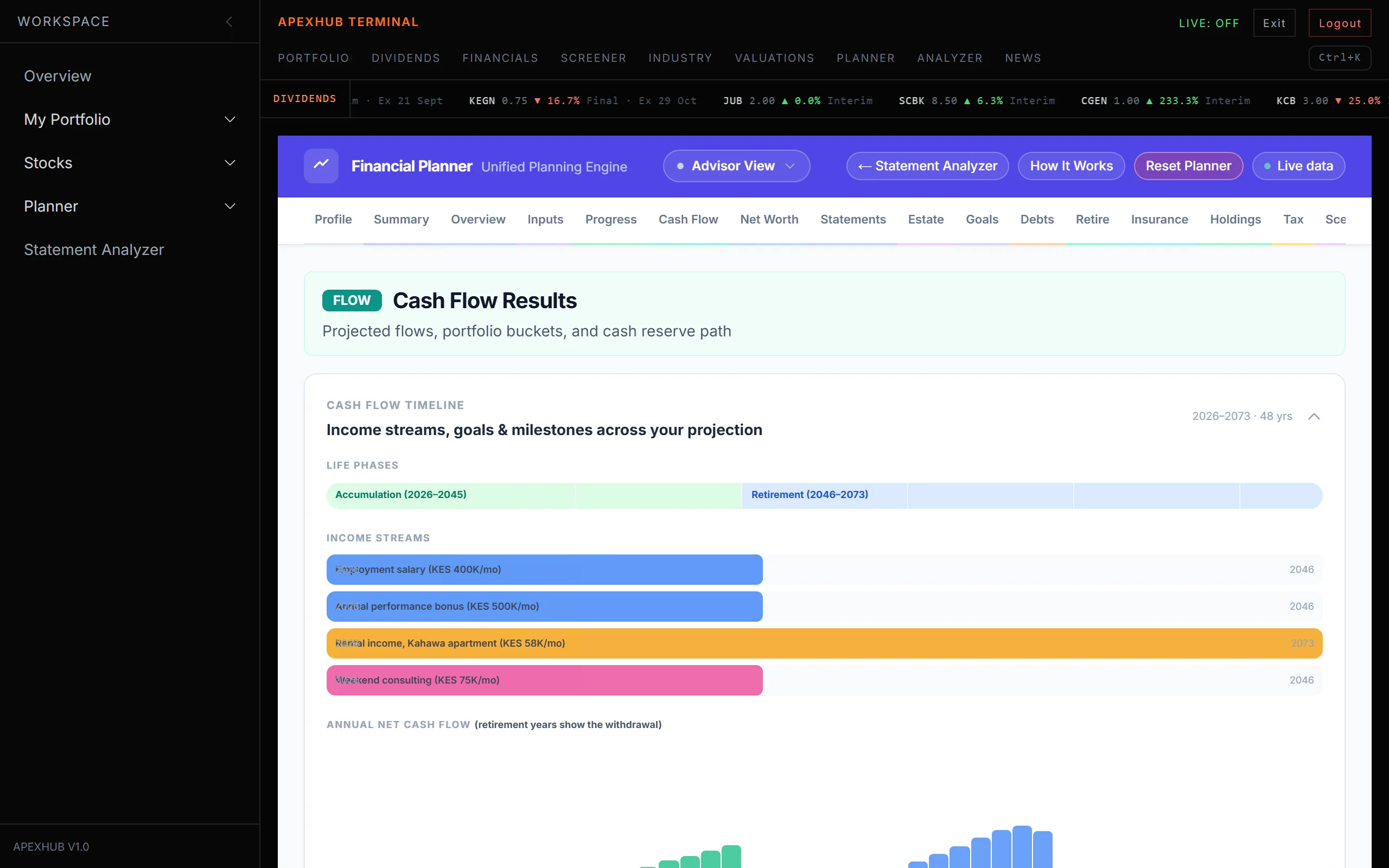
Cash flow · income streams, goals and milestones across the projection
Free tools
Free financial calculators for Kenya
You don’t have to begin with a full plan. Each tool answers one question, needs no account and uses the same engine as the planner.
Retirement Planner
The short version. A handful of inputs and a straight answer on whether the number you are heading for covers the retirement you want.
Personal Income Tax
Kenyan PAYE end to end: bands, personal relief, NSSF, SHIF, the Affordable Housing Levy, and what each deduction is actually worth to you.
Debt Payoff
Avalanche against snowball on your real balances, with fees and settlement penalties included, because the cheapest order is not always the highest rate.
Loan Repayment
What a loan really costs over its life, how much of each instalment is interest, and what an extra payment a month takes off the end.
Compound Interest
The one that changes behaviour. See what a monthly amount becomes over twenty years, and what waiting five years costs you.
Why the tax detail matters
Gross pay isn’t the number you plan with. PAYE, NSSF, SHIF and the Housing Levy come off first, and your reliefs change what’s left. Every tool applies the same rules, so the figures agree.
Who it is for
Where to start
Advisors and planners
Put a real engine behind the advice.
- Client workspaces, each with its own plan and history
- Suitability on record: risk questionnaire, capacity from the plan, mismatch flags
- A configurable client report with presets including a Statement of Advice
- Households of two or more adults modelled as separate taxpayers, polygamous ones included
Individuals and families
Find out where you actually stand.
- One place for the mortgage, the sacco loan, the school fees and the pension
- Goals priced in future money, not today’s, so the target is honest
- How much life cover your dependants would genuinely need
- What is left after probate, and what routing assets differently would save
Students and the curious
Learn on a finished plan instead of a blank page.
- Three worked demo households, seeded and ready to open
- Change one figure and watch every tab move
- A written guide explaining what each tab is for and how to read it
- Reset the demo whenever you like: nothing you do there touches a real plan
Getting started
How to build a financial plan in four steps
Start from a demo, not a blank page
Three households ship with the planner: one earner, a couple, and a polygamous household of three adults across two houses. Open one and every tab already has numbers in it.
Put your own position in
Income, expenses, debts, holdings, property, goals. Upload a bank statement if you would rather start from what you actually spend than from an estimate.
Read what the plan says
Cash flow, net worth, retirement readiness, financial statements and health ratios, projected to life expectancy. The gaps are the point: a plan reading 100 percent funded has nothing left to tell you.
Change something and see what it moves
Retire two years later. Claim the pension relief you are leaving unused. Pay the expensive debt first. Scenario sliders re-run the whole projection while you drag them.
Common questions
Financial planning FAQ
What is financial planning?
Financial planning is writing down what you own, what you owe and what you want, then checking whether the three agree over time. In practice it means projecting your income, expenses, tax, debts and savings forward year by year so you can see whether your goals are funded and which decisions change that.
How do I make a financial plan in Kenya?
Start with your real income and spending, apply Kenyan PAYE, NSSF, SHIF and the Housing Levy, list your debts and goals, then project the balance to retirement and beyond. The financial planner here does all of that in one model, and you can start from a worked demo household rather than a blank page.
How much do I need to retire in Kenya?
It depends on the income you want, how long it must last, and what your pension, NSSF and investments will have grown to by then. The retirement planner gives a quick answer from a handful of inputs, and the full planner models the drawdown month by month including tax on withdrawals.
How much of my pension contribution is tax deductible?
Kenya allows a pension deduction of up to 30,000 shillings a month per person against PAYE. It is an individual entitlement, so every earning adult in a household has their own limit and unused allowance cannot be transferred between them.
Can the planner model a polygamous household?
Yes. Kenya’s Marriage Act 2014 recognises polygamous customary and Islamic marriages, and the planner holds a household of more than two adults rather than approximating it as a couple plus one. Each adult is a separate taxpayer with their own bands, reliefs, retirement date, cover need and estate, and assets can be attached to a particular matrimonial house or split by explicit shares. A worked polygamous demo household ships with the planner.
Are these financial planning tools free?
The calculators are free and need no account. The full financial planner needs a free sign-in so your plan can be saved between visits.
Can I use the planner to learn, without entering my own money?
Yes. Three complete demo households ship with the planner: a single earner, a couple, and a polygamous household of three adults. Open any of them, change anything you like, and reset when you are done. Nothing you do in a demo touches a real plan.
Open a demo and change one number.
It is the fastest way to understand what a plan does. Nothing you touch in a demo affects a real plan, and you can reset it whenever you like.