Kenyan Banks' Profit Rises 17.7% to Ksh 306.3 Billion in 2025 as Bad Loans Persist, CBK Reports
The Central Bank of Kenya's Bank Supervision Annual Report 2025 shows sector profit before tax up 17.7 percent to Ksh 306.3 billion on cost cuts, even as total income fell 2.0 percent, the gross non-performing loan ratio eased to 16.0 percent, and banks flagged for non-compliance nearly tripled to 35.
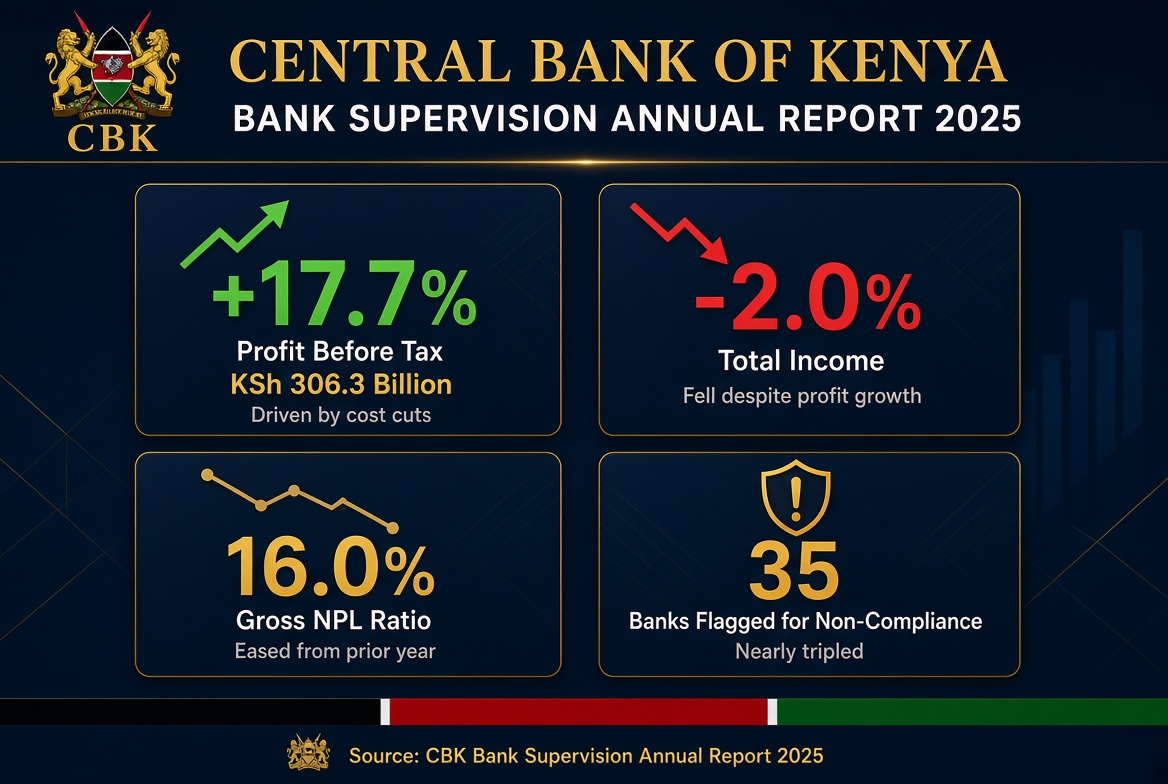
Kenyan banks' profit rises 17.7 percent to Ksh 306.3 billion in 2025 as cost cuts offset falling income, CBK says
The Central Bank of Kenya (CBK) says the banking sector's profit before tax rose 17.7 percent to Ksh 306.3 billion in the year to December 2025, up from Ksh 260.3 billion a year earlier. The regulator's Bank Supervision Annual Report 2025, covering commercial banks, microfinance banks, forex bureaus and other licensees, attributes the gain entirely to a Ksh 67.4 billion cut in total expenses, since total income actually fell 2.0 percent to Ksh 1.03 trillion.
That expense reduction traces mostly to interest costs. Interest expenses fell Ksh 96.9 billion, 25.1 percent, to Ksh 288.9 billion, as the sector's cost of funding eased and interest expense's share of total spending dropped to 39.8 percent from 48.6 percent. Profit growing faster than revenue is a cost story, not a demand story, and it is worth distinguishing the two when reading the headline number.
Balance sheet growth
Total net assets grew 10.3 percent to Ksh 8.35 trillion, up from Ksh 7.57 trillion a year earlier. That growth came mainly from government securities, up 18.2 percent, and loans and advances, up 6.6 percent, CBK said. Customer deposits, the sector's main source of funding, rose 11.6 percent to Ksh 6.12 trillion, while gross loans grew 6.8 percent to Ksh 4.35 trillion.
Asset quality improved, but unevenly
The gross non-performing loan ratio, the share of total loans not being repaid on schedule, eased to 16.0 percent in December 2025 from 17.1 percent a year earlier. Net non-performing loans fell 13.7 percent to Ksh 231.7 billion over the same period, CBK said.
That headline improvement hides an uneven shift underneath it. Loans in the Watch, Substandard and Doubtful categories, CBK's classifications for loans that are late but not yet written off, all shrank during the year, falling 7.4 percent, 9.3 percent and 6.4 percent respectively. Loans in the Loss category, the worst-risk bucket reserved for debt more than 360 days overdue, grew 22.8 percent instead. Part of that headline improvement is loans migrating into that worst bucket instead of genuinely recovering, CBK's own data shows.
Bad loans also stayed concentrated in a handful of sectors. Trade, Real Estate, Manufacturing and the Personal and Household segment together accounted for 72.6 percent of all non-performing loans in December 2025, CBK said, tracing the concentration to a challenging business environment across those sectors.
Capital and liquidity stayed comfortably above minimums
Capital and liquidity buffers stayed well above their regulatory floors. The sector's total capital to risk-weighted assets ratio stood at 20.7 percent, against a minimum of 14.5 percent, and core capital to risk-weighted assets came in at 18.2 percent, against a minimum of 10.5 percent. The average liquidity ratio rose to 59.3 percent, nearly three times the statutory minimum of 20 percent, from a year-earlier figure CBK's own report states two ways: 55.8 percent in one section and 56.0 percent in another.
CBK Governor Dr. Kamau Thugge described the sector's position in similar terms in his message accompanying the report. "The Kenyan banking sector registered improved financial strength in 2025, demonstrating stability and resilience," he said, pointing to those capital and liquidity ratios as evidence the sector could absorb shocks without support.
A shift in the competitive structure
The sector's peer-group structure shifted too. CBK classifies commercial banks into Large, Medium and Small peer groups using a weighted index of net assets, deposits, capital and reserves, and loan and deposit accounts. Standard Chartered Bank Kenya dropped out of the Large peer group into Medium this year, pulling the Large group's combined market share down to 69.7 percent from 75.6 percent. Sidian Bank moved up from Small to Medium too, and together the two moves lifted the Medium group's combined market share to 23.2 percent from 16.7 percent, CBK said.
No new mergers or acquisitions took place among commercial or microfinance banks in 2025, CBK said, a quiet year on that front given how often NSE-listed bank consolidation gets speculated about. The largest deal in view, Nedbank's proposed 66 percent stake in NCBA, was only announced in January 2026. The roster of listed banks has also grown since the report's cut-off. Family Bank joined the NSE by introduction on June 23, 2026, at KES 18.00 a share, and closed its first session at KES 26.00. It came to market with a disclosed NPL ratio of 13 percent at end-2025, below the sector's 16.0 percent, and with core capital lifted to 16.9 percent of risk-weighted assets by a KES 8.0 billion equity raise in 2025.
Compliance violations nearly tripled
Thirty-five commercial banks were in violation of the Banking Act or CBK's Prudential Guidelines as at December 31, 2025, up sharply from eleven banks a year earlier. Most of the violations traced to the revised Risk-Based Credit Pricing Model, breaches of the single-obligor lending limit, and failure to meet the minimum absolute capital requirement of Ksh 3 billion, CBK said.
That credit pricing model is worth explaining, since it sits behind a third of this year's violations. Banks began implementing it in 2022, following engagements with CBK that started in 2019, and it requires banks to price a loan's interest rate off a customer's individual credit risk instead of a flat, bank-wide rate. CBK revised the model in August 2025 to anchor its reference rate to the Kenya Overnight Interbank Average Rate (KESONIA), with the Central Bank Rate kept available as a fallback reference where KESONIA is not practical to use. The revised model took effect for new variable-rate loans on September 1, 2025, and extends to existing loans from February 28, 2026.
A first look at AI adoption
CBK surveyed the sector on artificial intelligence for the first time this year. Half of all surveyed institutions had adopted AI, comprising 66 percent of commercial banks, 57 percent of microfinance banks and 43 percent of digital credit providers. Every credit reference bureau surveyed reported no AI adoption at all.
Credit risk assessment was the leading use case, cited by 65 percent of institutions, followed by cybersecurity at 54 percent and customer service at 43 percent. Adoption is running ahead of governance, though. Only 30 percent of institutions have a formal AI strategy, and 93 percent of respondents want CBK to issue formal AI guidance, which the regulator says it is now developing.
A busy year for regulation
The AI survey was one of several regulatory moves CBK made in 2025. The regulator issued new Liquidity Coverage Ratio, Net Stable Funding Ratio and Leverage Ratio guidelines in April, cleared the Banking (Penalties) Regulations, 2025, through final parliamentary approval on December 2, and saw the Virtual Asset Service Providers Act come into force in November, bringing crypto and other virtual asset activity under joint CBK and Capital Markets Authority oversight.
Some of the year's reforms also responded to Kenya's placement on the Financial Action Task Force's grey list in February 2024, a designation for countries with weaknesses in fighting money laundering and terrorism financing that draws increased scrutiny of their cross-border transactions. CBK said it implemented a range of measures in 2025 aimed at addressing the gaps behind that listing.
Staffing grew, but not in management
Banking sector staff grew 5.9 percent to 41,124 employees in 2025, CBK said, but the increase was uneven. Clerical staff rose 21.3 percent, adding 2,588 positions, while management headcount fell 1.8 percent and supervisory roles fell 3.4 percent.
The results also reflect a broader economy that outperformed its peers, a backdrop that also fed into Moody's upgrade of Kenya's credit rating. CBK's report notes that Kenya navigated 2025 amid moderating global inflation, evolving trade dynamics and persistent geopolitical tensions, yet domestic growth held up on resilient services-sector activity and a rebound in industrial output. For a banking sector that draws much of its loan book from the Personal and Household, Trade and Manufacturing segments, that domestic resilience helps explain why asset quality improved overall even as bad loans stayed concentrated in a few of those same sectors.
Bottom line for investors: the headline profit and capital numbers look strong, but the sector's earnings quality is thinner than 17.7 percent profit growth suggests, since it came from cutting costs against falling income, not from selling more loans or services. For anyone holding or evaluating NSE-listed banks, including through the newly approved WSA Banking ETF, the figure worth tracking closely is the Loss-category NPL growth of 22.8 percent, not just the headline ratio's improvement to 16.0 percent, and the near-tripling of banks in regulatory violation to 35 is a compliance-cost signal worth watching into 2026.
Related reading
- NSE Approves WSA Banking ETF as Banking Stocks Lead the Rally
- How Often Should You Rebalance? What ApexHub's Walk-Forward Study Found
- Family Bank, One Month In: The Discount We Called Has Turned Into a Premium
- Equity Group Dividend 2026 Skyrockets to KSh 5.75 After Profit Surge
- Co-operative Bank Dividend Jumps to KSh 2.50 as Earnings Strength Surpasses Forecasts
- Absa Bank Kenya Raises Dividend 17% as Profit Hits KSh 22.9 Billion
- I&M Group Posts 36% Profit Surge Driven by Strong Interest Income in H1 2025
Source: Central Bank of Kenya, Bank Supervision Annual Report 2025 (data as at December 31, 2025), published September 21, 2026.
Question or correction?
Spotted a figure that looks wrong, or want something in this note explained? It comes straight to us, and is not published.
Related research
Run the numbers
- Industry Analysis
Sector-level ratios for every listed company we cover.
- Financial Planner
Goals, income, debt and net worth projected in one plan.
- Statement Analyzer
Turn bank statements into categorised income and expenses.
- Stock Screener
Screen the NSE on the same fundamentals this note is built on.