Investing in Kenya,compared after tax.
Every fund house quotes a headline rate. Almost none of them show you what is left after the management fee and the withholding tax, which is the only number you can actually spend. These tools put money market funds, unit trusts, Treasury and infrastructure bonds, NSE dividend payers and global equities on the same footing, then track what you decide to buy.
The calculators are free and need no account. The portfolio tracker and planner need a free sign-in so your holdings are saved.
There is no free lunch, only a trade you choose
What investing is
Putting money to work so it earns without you, and accepting some risk to do it.
Saving is setting money aside. Investing is committing it to something that produces a return: interest from lending to a bank or the government, dividends from part-owning a company, rent from a property, or growth in the price of the asset itself. The return is the payment you receive for two things, giving up the use of your money for a period, and carrying the risk that it does not work out.
Which means the central question is never which investment is best. There is no such thing. The question is which instrument matches the money you are investing: when you need it back, how much of a fall you could tolerate on the way, and what the tax treatment does to the yield once it is in your hands.
Get that match right and most of the work is done. Get it wrong and you end up selling a good asset at a bad moment because the school fees were due.
Cash is not the safe option, it is the shrinking one
Money in a current account earns nothing while prices rise. That is a guaranteed loss of purchasing power, taken quietly, every year. Investing is not about getting rich, it is first about not going backwards by default.
Time does the heavy lifting, not skill
Returns earned on returns are what turn a modest monthly amount into a serious balance, and the effect is almost all in the later years. Starting at 28 instead of 38 is worth more than any stock pick you are likely to make.
Income you did not work for
Dividends, coupon payments and fund distributions arrive whether or not you clocked in. Building a stream of them is how a salary stops being the only thing standing between you and your obligations.
The tax treatment changes the ranking
An infrastructure bond paying 13 percent tax free beats a corporate bond paying 14 percent with 15 percent withheld. Comparing headline rates without netting off tax and fees is the most common way Kenyan investors pick the wrong product.
Doing nothing is also a position
A balance sitting in a current account is not neutral. It is a decision to accept a real loss equal to inflation, every year, in exchange for convenience. That trade is perfectly reasonable for a month of expenses and very expensive for a decade of savings, and the difference between the two lines below is the whole argument for doing something about it.
The menu
What you can actually invest in
Nine families of instrument, with the three facts that decide between them: what it pays, how long your money is committed, and what Kenyan tax takes before it reaches you.
Money Market Funds
A pooled fund that lends short term to banks and the government. Priced daily, no lock-in, and withdrawals normally settle within a few working days.
- Pays
- Interest accrued daily, quoted as an annualised yield
- Horizon
- Days to about 2 years
- Risk
- Low
- Kenyan tax
- 15% withholding on distributions
- Best for
- Emergency fund, next term’s school fees, money waiting for a better idea
Unit Trusts and Balanced Funds
Professionally managed pools that hold bonds, equities or a mix. You buy units, the manager does the selection, and a management fee comes off the top.
- Pays
- Distributions plus growth in the unit price
- Horizon
- 3 years and up
- Risk
- Low to high, depending on the mandate
- Kenyan tax
- 15% withholding on distributions
- Best for
- Diversification without picking individual securities yourself
Treasury Bonds and Bills
Lending directly to the Government of Kenya through CBK. A bill is a discount instrument under a year; a bond pays a coupon every six months until it matures.
- Pays
- Semi-annual coupons, principal back at maturity
- Horizon
- 3 months to 30 years
- Risk
- Low credit risk, real price risk if you sell early
- Kenyan tax
- 10% on longer-dated Treasury bonds, 15% on shorter
- Best for
- Predictable income and a known maturity date to plan around
Infrastructure Bonds
Government paper issued to fund specific projects, and the reason so many Kenyan portfolios are built around them: the interest is exempt from withholding tax.
- Pays
- Semi-annual coupons, tax free
- Horizon
- Usually long dated
- Risk
- Same issuer as any Treasury bond
- Kenyan tax
- Exempt from withholding tax
- Best for
- The highest net yield available to a resident individual on low-risk paper
Dollar and Offshore Funds
USD-denominated fixed income and offshore funds, which have drawn heavy interest recently from savers who want the shilling out of the equation.
- Pays
- USD interest, plus or minus the exchange rate
- Horizon
- 2 years and up
- Risk
- Currency risk cuts both ways, do not read a strong year as a free lunch
- Kenyan tax
- Distributions taxed, currency gains depend on the wrapper
- Best for
- Obligations denominated in dollars, or diversifying away from a single currency
NSE Listed Shares
Direct ownership of Kenyan listed companies. You get the dividends and the price movement, and you carry the business risk yourself.
- Pays
- Dividends plus capital growth
- Horizon
- 5 years and up
- Risk
- High, and concentrated if you hold only a few counters
- Kenyan tax
- 5% withholding on dividends, capital gains tax on disposal
- Best for
- Long horizon money, and anyone who wants a rising income stream
Global and US Equities
Exposure to markets and sectors the NSE simply does not contain. The planner holds these in their native currency and converts at the boundary.
- Pays
- Dividends plus capital growth, in USD
- Horizon
- 5 years and up
- Risk
- High, with currency risk layered on top
- Kenyan tax
- Withholding at source, plus Kenyan treatment on remittance
- Best for
- Diversifying a portfolio that is otherwise entirely one small market
Exchange Traded Funds
A fund that trades like a share, so one order buys a whole index or a commodity. The NSE lists the Absa NewGold ETF on bullion, the Satrix MSCI World Feeder for global equities, and the newly approved WSA Banking Index ETF on local bank shares.
- Pays
- Distributions where the fund pays them, plus the price of the units
- Horizon
- 5 years and up, or as long as you want the exposure
- Risk
- Whatever the index carries, without the single-company risk
- Kenyan tax
- 5% withholding on distributions, NSE-listed units exempt from CGT
- Best for
- Gold, global equities or the banking sector in one order, without picking counters
SACCOs and Property
The two most common Kenyan holdings that never appear on an exchange. SACCO deposits pay an annual dividend on shares; property pays rent and is the least liquid thing most people own.
- Pays
- SACCO dividends, or rental income net of costs
- Horizon
- Long, and hard to exit quickly
- Risk
- Concentration and liquidity rather than daily volatility
- Kenyan tax
- Rental income under the monthly rental regime, SACCO dividends withheld
- Best for
- Investors who already hold these and need them inside one net worth picture
Tax rates shown are the standard treatment for a resident individual and are there to make the comparison concrete, not to serve as tax advice. Rates change with each Finance Act and specific issues carry exceptions, so confirm the current position before you commit money.
Dividends
For a lot of Kenyan investors the NSE is not a growth story at all, it is an income story. You buy a bank or a utility because it pays, and the question you care about is how much is coming, when it lands, and whether the company can keep paying it. That is a different question from what a share is worth, and it deserves its own tools.
Dividend income is lumpy
Kenyan companies concentrate their payments around results season, so an annual yield tells you nothing about the month a bill falls due. The calendar shows when the market pays; your portfolio turns that into when you get paid.
A high yield is sometimes a warning
Yield rises when the price falls. Before buying a counter for its 12 percent, check whether earnings cover the payout, because the market may simply be pricing in the cut that has not been announced yet. The dividend discount model is where you test that.
Value a dividend payerMatching money to instrument
Start from the date, not the product
When you need the money back is the single most useful thing you know about it, and it narrows the menu faster than any risk questionnaire. Everything else is refinement.
Money you will need soon
Money market fund, Treasury bills
Nothing that can be down when you need it. Return is not the objective here, availability is.
A known, dated commitment
MMF, short Treasury bonds, bond ladder
Match the maturity to the date. A ladder gives you a rung falling due each year.
Building something
Bonds, balanced funds, a first equity sleeve
Long enough to accept some volatility, short enough that an all-equity position is a gamble.
Retirement and legacy money
NSE and global equities, index ETFs, property, pension
The only horizon where equity risk is genuinely being compensated. Volatility stops being the risk that matters.
When you cannot pick one date, build a ladder
Splitting money across bonds that mature in successive years means something falls due every year. You never have to sell into a bad market to raise cash, and you reinvest gradually instead of committing everything at one moment's rates. The bond ladder calculator builds the schedule and shows the income it throws off each year.
Build a bond ladderInvestment calculators
Six calculators, one workspace
All six live on the same page as tabs, and each remembers what you typed, so you can move between them while comparing the same amount of money.
Compound Interest
What a monthly amount becomes, at any compounding frequency.
Money Market Fund
Daily accrual, management fee and 15 percent withholding, netted off.
Unit Trust
Unit pricing, initial and annual fees, and distributions over your horizon.
Bonds
Coupon schedule, clean and dirty price, yield, and tax by bond category.
Bond Ladder
Stagger maturities so something falls due every year instead of all at once.
Compare Funds
MMF, bond plus, balanced, equity and dollar funds side by side, after fees and tax.
The comparison workspace is the one to use first
Put a money market fund, a bond plus fund, a balanced fund, a dollar fund, a direct Treasury bond and an infrastructure bond in the same table, apply each one's fees and withholding tax, and rank them on what you would actually receive. Fund-house presets are included as illustrative starting points and every field stays editable, so you should replace them with the current published figures before deciding anything.
Open the calculatorsHow the tools help you decide
Every number here comes from somewhere
A projection is only as good as what it was built from, so it is worth knowing which of these four sources is behind each answer, and where your own judgement is the input that matters.
The calculators
Amount, monthly contribution, rate, fees, withholding tax and horizon. Nothing is assumed on your behalf, and every projection shows the schedule behind the headline number rather than just a final figure.
Open the calculatorsDividend and price history
Declared dividends, payout history and yields for NSE counters, drawn from the same feed as the screener. Your portfolio income is computed from what companies actually paid, not from a guess.
Track your portfolioThe valuation models
Published annual financial statements, prepopulated into DCF, dividend discount and multiples models. You change the forecast and cost of capital, the accounts stay fixed.
See the modelsThe planner and optimisers
Live US quotes and NSE prices mark your holdings to market, feed net worth, and drive the portfolio optimisers that turn a list of picks into actual weights.
Open holdings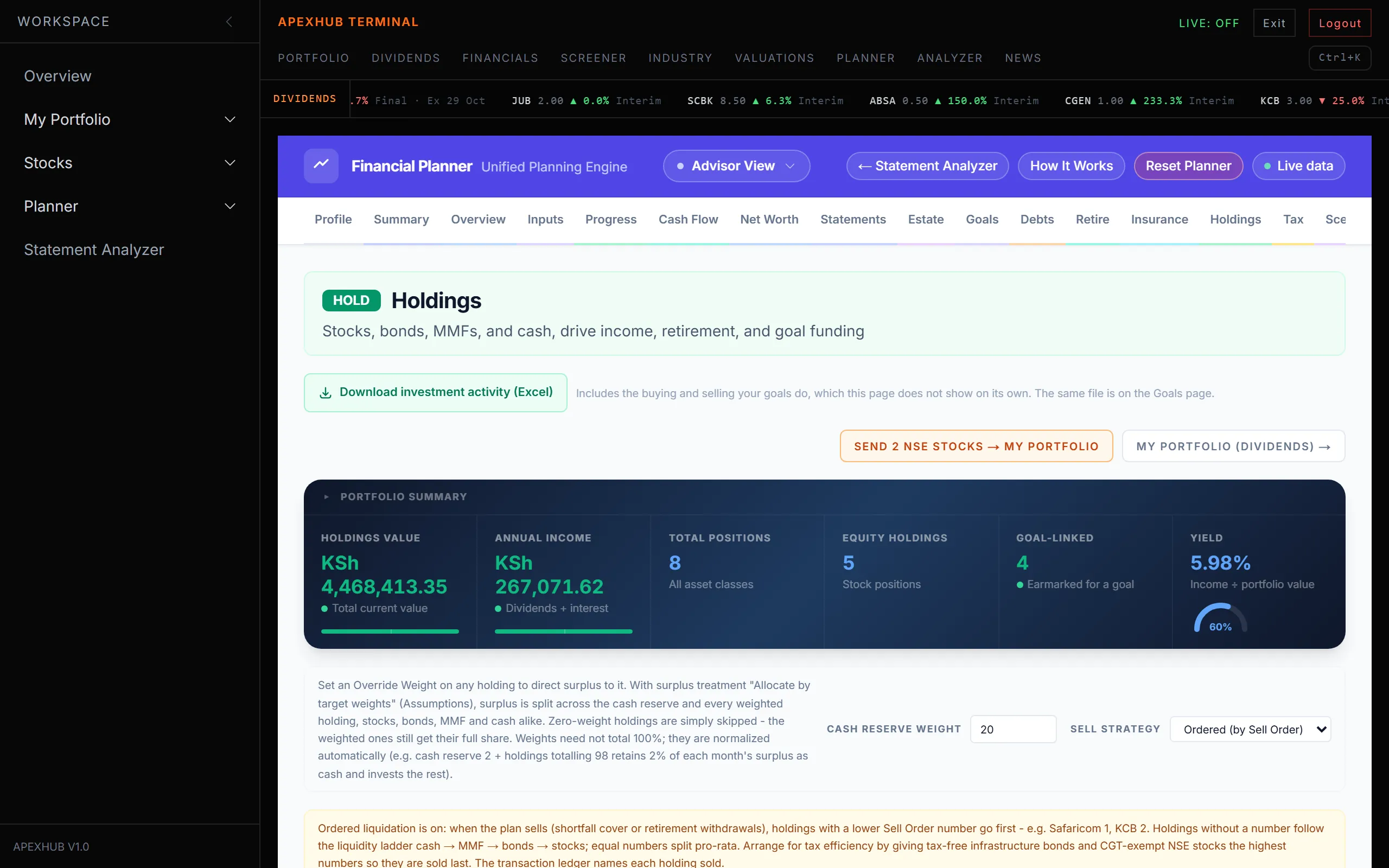
Holdings · value, income and yield across every position you hold
Where your portfolio lives
Two ways to hold it, depending on the question
My Portfolio
The lightweight tracker for Kenyan shares. Enter your tickers and share counts and it works out the dividend income due, pulls the declaration and pay dates, charts your income history, and shows news on the counters you actually own.
- Expected dividend income per counter, net of the 5 percent withholding
- Historical yield and payout per share, year by year
- News filtered to your holdings rather than the whole market
- Hands the positions over to the planner when you want the full picture
Planner Holdings
The full model, for when the question is not just what your shares are worth but whether the whole plan works. Holds stocks, bonds, money market funds and cash together, in shillings or dollars, and feeds them into a lifetime projection.
- Live US quotes alongside NSE prices, converted at the boundary
- Bonds with real coupons and maturity dates, MMFs with their own yields
- Surplus income allocated across holdings by the weights you set
- Capital gains and withholding modelled where they actually apply
Once you have picks, decide the weights
Choosing what to own and choosing how much of each are separate problems, and the second is where most of the risk actually gets set. The portfolio optimisers take your candidates and historical returns and find the allocation with the best return per unit of risk, rather than splitting evenly and hoping.
Getting started
Four steps, in this order
Fund the buffer before anything else
Three to six months of expenses somewhere you can reach in a week. Until that exists, every other investment is really a loan you will be forced to call in at the worst moment. A money market fund is the usual home for it.
Put a date on each pot of money
School fees in September, a deposit in four years, retirement in twenty two. The date decides the instrument far more reliably than your appetite for risk does, and it is the one input people skip.
Compare after tax and after fees, never before
Run the candidates through the same calculator with withholding tax and management fees switched on. A headline yield is a marketing number. What lands in your account is the only figure worth ranking on.
Track what you own, then rebalance deliberately
Record the holdings, watch the dividends land, and check the weights once or twice a year. Drift is what turns a balanced portfolio into an accidental bet on whatever went up most.
Common questions
Investing FAQ
What is investing?
Investing is committing money to an asset in the expectation that it produces more money over time, through income such as interest or dividends, growth in value, or both. It differs from saving in that you accept some risk of loss in exchange for a return that has a chance of beating inflation.
Why is investing important in Kenya?
Because uninvested cash loses purchasing power every year that prices rise, which is a guaranteed real loss. Investing is how you protect the value of what you have earned, build income that does not depend on your salary, and accumulate enough for goals such as school fees, a home or retirement that no monthly budget alone will reach.
What can I invest in as a Kenyan?
The common menu is money market funds, unit trusts and balanced funds, Treasury bills and bonds, infrastructure bonds, corporate bonds, shares listed on the Nairobi Securities Exchange, dollar and offshore funds, SACCO deposits, pension schemes and property. They differ mainly in what they pay, how quickly you can get your money back, and how they are taxed.
Which investment is best for a beginner?
Most people start with a money market fund because there is no lock-in, the minimum is small and the value does not swing. It is the right home for an emergency fund. Once that buffer exists, longer-dated money can move into bonds, funds or equities depending on when you will actually need it.
How are dividends taxed in Kenya?
Dividends from NSE-listed companies are subject to 5 percent withholding tax for resident individuals, deducted before the money reaches you, and that is generally final. Interest distributions from money market funds and unit trusts are withheld at 15 percent, Treasury bond interest at 10 or 15 percent depending on tenor, and infrastructure bond interest is exempt.
What is a bond ladder and why would I use one?
A bond ladder splits your money across bonds maturing in successive years rather than putting it all into a single maturity. Something falls due every year, so you get regular access to cash without selling at whatever price the market happens to offer, and you reinvest gradually instead of locking the whole amount in at one moment’s rates.
Are infrastructure bonds really better than higher-yielding alternatives?
Often, yes, because the interest is exempt from withholding tax. A tax-free 13 percent is worth more than a taxed 14 percent, which nets down to about 11.9 percent after 15 percent withholding. This is exactly the comparison the bond and fund comparison calculators are built to make explicit.
Are these investment tools free?
The calculators are free and need no account. The portfolio tracker and the planner need a free sign-in so your holdings and plan are saved between visits.
Compare two funds after tax, then start.
It takes about a minute and it is usually the point at which the obvious choice turns out not to be the obvious choice. Then record what you buy, so next year you are working from what happened rather than what you meant to do.
Backtests, walk-forward models, and projections shown here are experimental mathematical tools applied to historical public disclosures, for quantitative research and educational purposes only. Historical model accuracy does not guarantee future results, and the outputs are not forecasts, valuation guarantees, price targets, or solicitations to trade.
Outputs are built from user-supplied inputs and historical disclosures. Nothing here is an offer, solicitation, or personalized recommendation to buy, sell, or trade any security, financial instrument, or insurance product, or a substitute for professional financial, tax, legal, or estate planning advice.